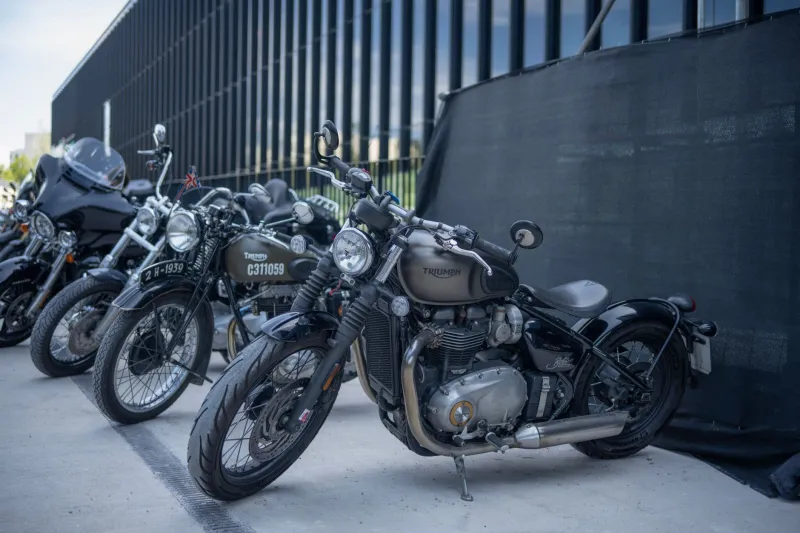
Wrenches and Wort: What Motorcycle Mechanics and Craft Brewers Have in Common
There's a particular kind of person who can't leave a problem alone. They'll pull a carburetor apart at midnight just to understand why it's running rich. They'll brew the same pale ale six times in a row, tweaking the grain bill by a quarter pound each time, chasing a flavor profile that exists mostly in their head. These people are annoying at dinner parties and absolutely irreplaceable in a garage or a brewery.
As it turns out, they're often the same person.
The Garage Is Just a Brewhouse You Haven't Finished Yet
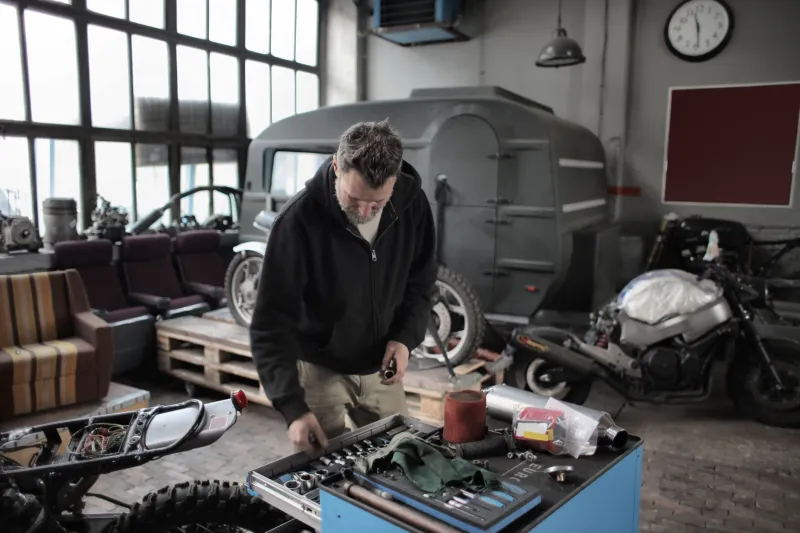
Walk into Gary Teschner's workspace in Asheville, North Carolina, and you need a second to figure out what you're looking at. There's a 1974 Norton Commando in various stages of resurrection on one side of the room. On the other, a three-vessel homebrew setup that's been slowly upgraded over the past decade into something that wouldn't embarrass a small commercial operation. The smell is equal parts solvent and malt.
"People ask me how I got into brewing," Gary says, not looking up from a valve he's lapping by hand. "I tell them I never got out of the garage. I just started making something drinkable in it."
Gary spent twenty years as a motorcycle restoration specialist before his homebrew habit turned into a side business selling kegs to local taprooms. He didn't think of the transition as a career pivot so much as a natural extension of how his brain already worked. "Both of them punish sloppiness," he says. "You can't fake your way through a carb rebuild, and you can't fake your way through fermentation. The machine knows. The yeast knows."
Temperature Is Everything — Ask Any Mechanic or Any Brewer
If there's one variable that unites the two disciplines, it's thermal management. Motorcycle engines live and die by their ability to handle heat. Oil viscosity, coolant flow, combustion timing — a seasoned wrench-turner develops an almost intuitive sense for temperature, reading an engine the way a doctor reads a patient.
Brewing demands the same sensitivity in the opposite direction. Mash temperature determines which enzymes activate and which don't, shaping the body and fermentability of the wort. Fermentation temperature controls yeast behavior, flavor compound production, and whether you end up with something complex and clean or something that tastes like nail polish remover.
Jessica Morales, head brewer at a small craft operation outside Austin, Texas, came to brewing through a decade of working on vintage Ducatis. She laughs when you point out the thermal parallel. "I used to say I could feel when a Desmo was running hot before the gauge moved," she says. "Now I say the same thing about my fermenters. You develop a relationship with the system. You learn its moods."
Her brewery keeps detailed logs for every batch — temperature curves, gravity readings, pH checks at multiple stages. Her motorcycle restoration notebooks from the nineties look almost identical. Date, condition, measurement, deviation, correction. The methodology is the same. Only the subject changes.
Troubleshooting as a Philosophy
One of the things that separates a true enthusiast from a hobbyist — in either world — is their approach to failure. A hobbyist gets frustrated when something goes wrong. An enthusiast gets interested.
In motorcycle restoration, troubleshooting is practically a spiritual practice. A bike that won't idle right could have a dozen causes. You eliminate variables systematically, or you develop a feel for the likely culprit through accumulated experience. Either way, the answer is in the details, and finding it requires patience that most people simply don't have.
Brewing troubleshooting follows the same logic. An off-flavor in the finished beer — a hint of sulfur, an unexpected tartness, a cloying sweetness that wasn't in the recipe — sends experienced brewers back through every decision point. Water chemistry? Grain crush? Pitch rate? Fermentation temp? The variables stack up fast, and isolating the cause demands exactly the kind of systematic, ego-free thinking that makes a great mechanic.
"The worst thing you can do in either situation is guess and move on," says Marcus Webb, who runs a custom bike shop and a nanobrewery out of the same building in Kansas City. "If you guess and you're right, you didn't learn anything. If you guess and you're wrong, you've made it worse and you still don't know why."
Marcus started homebrewing because he got tired of spending money on beer he could theoretically make himself. Sound familiar? That's the same logic that sends riders into motorcycle restoration — a stubborn conviction that you can do it better, or at least learn something trying.
The DIY Ethos That Connects It All
Both motorcycle culture and the craft brewing movement were built on a rejection of the mass-produced. The original custom bike builders of the postwar era weren't just making transportation — they were making a statement about individuality, about refusing the factory default. The craft beer revolution of the 1980s and '90s said the same thing about Budweiser and Miller that those early chopper builders said about the showroom floor: this doesn't have to be the only option.
The tools changed. The spirit didn't.
What you find, when you spend time in the overlap between these two worlds, is a community of people who are fundamentally allergic to mediocrity. They're not necessarily perfectionists in a rigid sense — most of them will tell you that some of the best bikes and some of the best beers came from happy accidents. But they're committed to understanding their craft deeply enough that the accidents become interesting rather than just costly.
"There's no shortcut to knowing your machine," Jessica says, back in her Austin taproom, pouring a sample of a dry-hopped saison she's been developing for three months. "Whether it's a motorcycle or a brew system, you have to log the hours. You have to make the mistakes. You have to care enough to figure out why."
She slides the glass across the bar. It's excellent — floral and bright with a dry, biscuity finish. Somewhere in Asheville, Gary Teschner is probably getting the same satisfaction out of a Norton that finally idles smooth.
Different machines. Same obsession. Same hands.