The Long Game: What Bourbon Aging and Bike Restoration Teach Us About the Virtue of Waiting
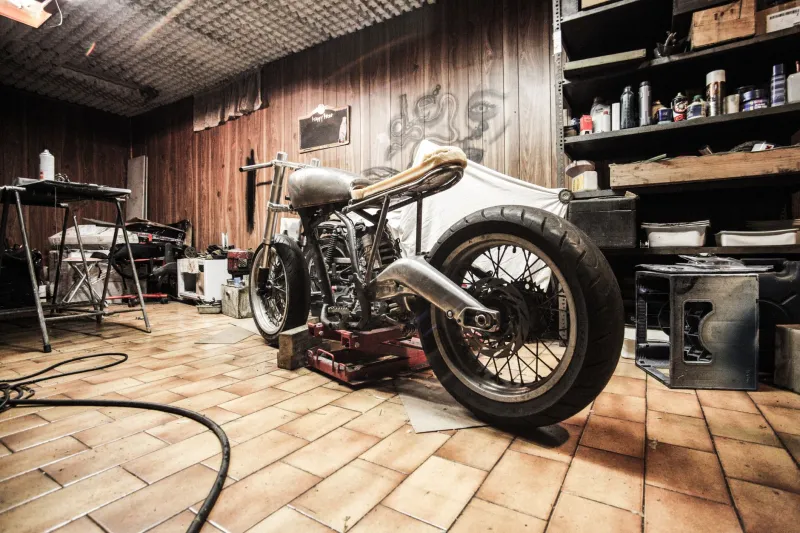
There's a 1967 Triumph Bonneville sitting in a garage outside Lexington, Kentucky, that hasn't turned a wheel under its own power in over two decades. Its owner, a retired machinist named Dale Pruitt, isn't in any particular hurry to change that. "She'll be ready when she's ready," he says, wiping grease from his hands with the same unhurried calm you'd expect from a man who also happens to keep a small collection of single-barrel bourbons tucked away in a climate-controlled closet down the hall. "Same philosophy, honestly."
Dale isn't alone in drawing that line between the two obsessions. Across the country, a particular breed of enthusiast has quietly figured out what the rest of us are slowly catching on to: the psychological process of restoring a vintage motorcycle and the discipline of aging a truly exceptional bourbon run on the same internal clock. Both demand patience as a practice, not just a personality trait. Both reward obsessive documentation. And both ask you to trust a process that, by design, resists being rushed.
The First Assessment: Reading What's There
Ask any master distiller what the hardest part of their job is, and a surprising number will tell you it's the initial evaluation—understanding what the raw spirit is telling you before you ever think about what it might become. The same thing happens in a restoration bay.
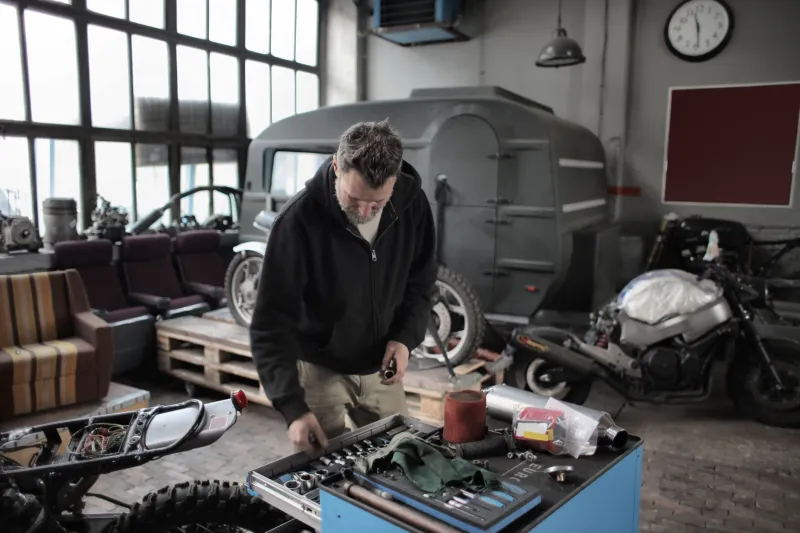
Jimmy Hargrove runs a small restoration shop out of Nashville and has been turning wrecks into show pieces for going on thirty years. When a project bike rolls through his doors, he doesn't reach for a wrench. He reaches for a notepad. "I walk around it for a good twenty minutes before I touch anything. I'm reading it. What's original, what's been messed with, where did the previous owner make decisions I'm going to have to live with?"
A distiller doing barrel entry evaluations talks almost identically. They're looking for the fingerprint of the grain, the influence of the yeast, the character that's going to carry through years of wood contact. You can't improve what you don't understand. In both crafts, the diagnosis is half the work.
Documentation as Devotion
One of the more surprising overlaps between serious restorers and serious bourbon people is the paperwork. Not glamorous, but ask anyone deep in either world and they'll tell you the logs are sacred.
Bourbon distilleries track everything: barrel entry proof, warehouse location, ambient temperature variations, rotation schedules. It reads like an engineering document, except what it's really tracking is time itself—the slow chemical conversation between wood and spirit. Pull a barrel without knowing its full history and you're guessing. And in this business, guessing is expensive.
Dale Pruitt keeps a three-ring binder on every bike he's ever touched. Part numbers sourced, vendors used, original paint codes cross-referenced against factory documentation. Photos at every stage. "If I ever sell her, the next owner deserves to know her story," he says. "And if I never sell her, I deserve to know I did it right."
That dual motivation—accountability to the machine and accountability to yourself—shows up in both communities with striking consistency. It's not record-keeping for its own sake. It's reverence made practical.
The Temptation to Shortcut
Here's where both paths get genuinely hard. There will always be a pressure—external or internal—to speed things up.
In bourbon, it's the temptation to pull barrels early, chase a trend, or use accelerated aging techniques that promise the same flavor profile in a fraction of the time. Some distilleries have experimented with smaller barrels, pressure cycling, even ultrasound. A handful have made it work. Most haven't. The wood needs time to do what wood does. There's no negotiating with chemistry.
In a restoration, the shortcuts are even more seductive because they're often invisible—at least at first. Replacement parts that are close but not correct. Paint that matches under fluorescent lights but not in sunlight. A rebuilt carburetor that runs fine until it doesn't. Hargrove has seen it all, and he has a standard line for customers who push him on timelines: "You can have it fast, or you can have it right. I've never been able to do both at the same time."
The willingness to sit with incompleteness—to let a project exist in process rather than forcing it to a conclusion—is genuinely difficult. It runs counter to most of how modern life operates. Which might be exactly why people who find their way into these hobbies tend to hold onto them so fiercely.
Respect for the Original
There's a philosophical tension that both master distillers and serious restorers navigate constantly: how much of yourself do you put in, and how much do you step back and let the original thing speak?
The best bourbon makers will tell you their job is largely to not get in the way. Select good grain, manage fermentation carefully, make honest cuts, choose the right barrel, find the right warehouse position—and then leave it alone. The spirit wants to become something. Your job is to create the conditions and resist the urge to overengineer.
Restorers who work at the highest level carry the same instinct. The goal isn't to make the bike better than it was. It's to return it to what it was—to honor the decisions the original engineers and craftsmen made, even when those decisions seem strange or inefficient by modern standards. An original-spec carburetor jets differently than a modern equivalent. That's not a flaw. That's the character.
"I'm not putting my name on this bike," Hargrove says. "I'm putting the factory's name back on it. My job is to disappear."
What You're Really Waiting For
When you ask Dale Pruitt when the Bonneville will be finished, he gets a little quiet. Then he says something that sounds simple but takes a second to land: "I'm not sure I want it to be finished."
That's not procrastination talking. It's something closer to wisdom. The process of restoration, like the process of aging, has its own rewards that exist independent of the endpoint. The research, the sourcing, the problem-solving, the slow accumulation of knowledge about a specific machine or a specific spirit—that's the actual experience. The finished product is the proof. But the work is the point.
Pour a glass of something that's been sitting in white oak for twelve years and you're not just tasting bourbon. You're tasting every decision made along the way, and the courage it took to leave it alone long enough to find out if those decisions were right.
Roll a restored Bonneville out into the morning sun and fire it up for the first time in twenty years, and you're not just hearing an engine. You're hearing time itself, given back.
Some things are worth waiting for. The people who understand that tend to find each other eventually—usually in a garage, usually with something good in their glass.