Your Brain on Asphalt: Why Riders Develop More Sophisticated Palates Than Almost Anyone Else
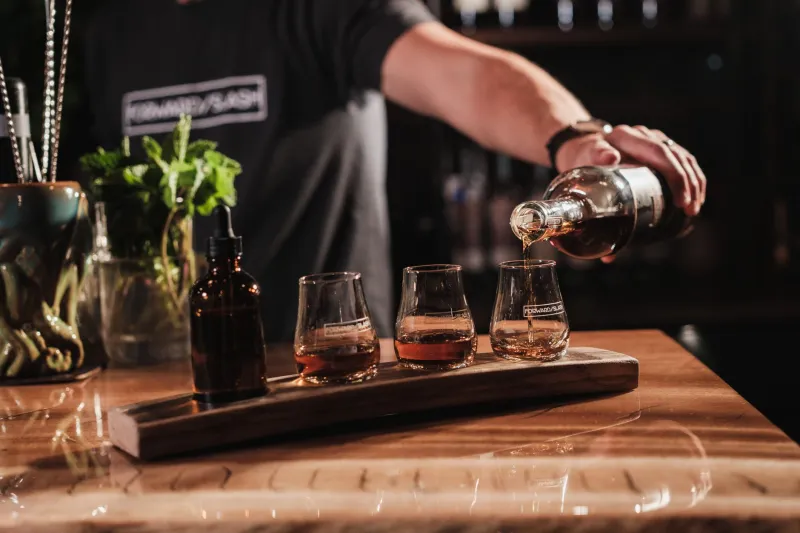
You've probably noticed it without ever putting words to it. You roll in after a couple of hours of hard riding — mountain switchbacks, open highway, whatever your preferred flavor of freedom — and suddenly that cold craft IPA or that pour of small-batch bourbon tastes extraordinary. More layered. More alive. Like your mouth grew extra sensors while you weren't paying attention.
That's not your imagination. That's your neurochemistry doing something genuinely remarkable, and the science behind it goes a lot deeper than "you were thirsty."
The Adrenaline Architecture of a Good Ride
When you throw a leg over and twist the throttle, your body doesn't just wake up — it fundamentally restructures its operating priorities. Adrenaline (epinephrine) floods your system, followed by norepinephrine and cortisol. Your pupils dilate. Your heart rate climbs. Blood flow redirects toward your muscles and away from non-essential systems.
But here's where it gets interesting for anyone who cares about what they're drinking afterward.
"The same neurochemical cascade that heightens threat detection and motor precision also amplifies sensory processing across the board," explains Dr. Mara Castillo, a neuroscientist at the University of Colorado who studies sensory modulation under stress. "After that arousal state begins to resolve — what we call the comedown window — the nervous system doesn't immediately return to baseline. There's a period of heightened sensory sensitivity that can last anywhere from 30 minutes to a couple of hours."
In plain English: your senses are still running hot when you park the bike and reach for a drink. And that changes everything about how flavor registers.
Taste Isn't Just Your Tongue
Most people think of tasting as a tongue-level event. Sweetness here, bitterness there, salt somewhere in the middle. But actual flavor perception is a full-brain exercise, integrating signals from your taste buds, your olfactory system, your trigeminal nerve (which handles heat, texture, and carbonation), and your limbic system, which ties it all to memory and emotion.
When your nervous system is in a post-ride elevated state, the olfactory and limbic connections get a serious boost. Retronasal smell — the kind that happens when aromatic compounds travel from the back of your mouth up into your nasal cavity — becomes dramatically more acute. This is the mechanism responsible for detecting most of what we call "complex" flavor: the vanilla and toasted oak in a good bourbon, the stone fruit and resinous hop character in a well-built IPA, the earthy funk in a farmhouse ale.
Casual drinkers at rest might register those compounds as background noise. A rider in that post-ride sensory window catches every one of them.
"It's analogous to what happens to professional tasters when they use structured palate-priming techniques before an evaluation," says James Whitfield, head distiller at a small-batch Kentucky whiskey operation who spent years training competition judges. "They're deliberately elevating their sensory readiness. Riders are getting there organically, through the experience of the ride itself. Some of the most accurate tasting notes I've ever heard came from people who'd just gotten off a motorcycle."
Why Craft Beverages Hit Different — and Why That's Not a Coincidence
The motorcycle community's gravitational pull toward craft beer, artisan spirits, and specialty coffee isn't purely cultural, though culture certainly plays a role. It's also neurological self-selection.
When you're wired with a heightened sensory system post-ride, mass-produced beverages tend to fall flat. They're engineered for consistency and broad palatability — meaning they're deliberately smoothed out, with minimal complexity, designed to offend no one. For a nervous system running at elevated sensitivity, that translates to a drink that feels thin, one-dimensional, almost boring.
Craft beverages, by contrast, are built with intentional complexity. A well-aged rye whiskey might carry notes of black pepper, dried cherry, baking spice, and a long mineral finish. A hazy double IPA from a thoughtful small brewery layers tropical fruit, dank resin, and a soft bitterness that evolves as it warms in the glass. These are drinks that reward a tuned-up palate. They give your elevated sensory system something to actually work with.
"Riders aren't just seeking flavor — they're seeking stimulation that matches their internal state," Dr. Castillo notes. "After an experience as sensory-rich as a long ride, your brain is primed to engage with complexity. A flat, simple drink feels like a mismatch. A layered, nuanced one feels like a continuation of the experience."
The Dopamine Loop You Didn't Know You Were Running
There's another mechanism worth understanding: the dopamine reward loop. Riding triggers significant dopamine release — particularly in technical or adventurous riding where moment-to-moment decision-making is constant. Dopamine is intimately tied to novelty-seeking and reward anticipation.
Craft beverage culture, it turns out, is one of the most dopamine-friendly consumer categories in existence. Limited releases, seasonal rotations, single-barrel expressions, experimental hop varieties — every element is designed to deliver novelty. For a brain freshly stoked on riding-induced dopamine, the hunt for the next interesting pour isn't just pleasant. It's neurologically compelling.
This is likely why so many serious riders eventually become genuinely obsessive about what they drink. It's not affectation. It's the same brain wiring that makes them want to find a better road, a tighter line, a more interesting route. The appetite for discovery doesn't clock out when the engine does.
What This Means for How You Drink After a Ride
None of this is an argument for drinking more. It's an argument for drinking better — and being intentional about the window you're in when you do it.
If you're rolling off a long ride in that elevated sensory state, that's the moment to break out the bottle you've been saving. The expression you've been curious about. The small-batch release from that distillery you rode past three states back. Your palate is operating at something close to peak capacity, and a complex, well-made drink will reveal more of itself to you in that window than it would on a quiet Tuesday evening on the couch.
Conversely, don't waste that window on something forgettable. Your brain built a remarkable sensory instrument through years of riding. Give it something worth tasting.
The road primes you. The pour rewards you. That's not coincidence — it's chemistry. And it's one more reason why the connection between riding culture and craft beverages runs a lot deeper than a shared aesthetic.
Ride hard. Drink well. Your nervous system already knew what it was doing.